








Medical treatment doesn’t always lead to the desired result. Even when healthcare providers follow accepted standards of care, complications, side effects, and unexpected outcomes can occur. For patients and families, it can be difficult to determine whether a poor result is simply an unfortunate medical reality or something more serious—like negligence.
Understanding the distinction between a bad outcome and medical negligence is critical, especially if you’re considering legal action. Not every adverse result qualifies as malpractice, and knowing where that line is drawn can help you make informed decisions about your next steps.
What Is Considered a Bad Outcome?
A bad outcome refers to a situation where a patient’s condition does not improve—or may even worsen—despite appropriate medical care. Medicine is not an exact science, and even well-trained professionals can’t guarantee results.
For example, a patient may experience complications after surgery, have an adverse reaction to medication, or fail to respond to treatment. These outcomes can be distressing, but they are not necessarily the result of wrongdoing.
Healthcare providers are expected to follow established standards of care, but they are not expected to deliver perfect results every time. As long as the care provided aligns with what a reasonably competent professional would have done under similar circumstances, a negative outcome alone does not constitute negligence.
Defining Medical Negligence
Medical negligence occurs when a healthcare provider fails to meet the accepted standard of care, and that failure directly causes harm to the patient. This is the foundation of most medical malpractice claims.
To establish negligence, several elements typically need to be proven:
-
Duty of care: The provider had a professional obligation to treat the patient.
-
Breach of duty: The provider failed to meet the accepted standard of care.
-
Causation: The breach directly caused the patient’s injury.
-
Damages: The patient suffered measurable harm as a result.
If any of these elements are missing, a malpractice claim may not be viable. This is why many adverse medical outcomes do not lead to successful legal cases—they simply do not meet the legal threshold for negligence.
Key Differences Between the Two
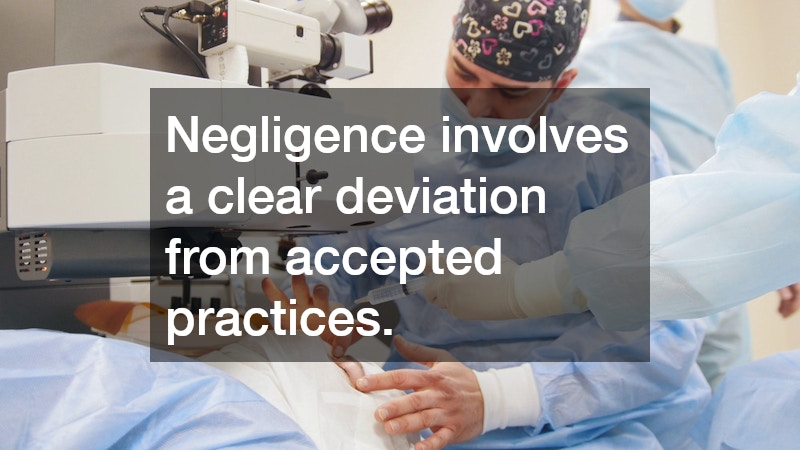
The primary difference between a bad outcome and medical negligence lies in whether the provider acted appropriately. A poor result can still occur even when the correct procedures were followed, while negligence involves a clear deviation from accepted practices.
For instance, if a surgeon performs a procedure correctly but the patient develops a known complication, that would likely be considered a bad outcome. However, if the surgeon makes a preventable error—such as operating on the wrong site or failing to follow basic surgical protocols—that may constitute negligence.
Another important distinction is foreseeability. Some risks are inherent in medical treatment and are typically disclosed to patients beforehand. When those known risks occur, they are generally not considered negligent unless the provider failed to properly inform the patient or took unnecessary risks.
The Role of Informed Consent
Informed consent plays a significant role in distinguishing between acceptable outcomes and potential negligence. Before undergoing treatment, patients have the right to be informed about the risks, benefits, and alternatives involved.
If a provider fails to adequately explain these factors, and the patient suffers a complication they were not warned about, it could strengthen a claim of negligence. However, if the risks were clearly communicated and the patient agreed to proceed, the same complication may be viewed as an accepted possibility rather than malpractice.
Documentation is key in these situations. Medical records and consent forms often serve as critical evidence in determining whether a patient was properly informed.
Common Examples That Raise Questions
Certain scenarios frequently lead patients to question whether negligence occurred. Misdiagnosis or delayed diagnosis is one of the most common. If a provider fails to recognize symptoms that another competent professional would have identified, and that delay leads to harm, it may qualify as negligence.
Medication errors are another area of concern. Prescribing the wrong drug, incorrect dosage, or failing to account for allergies can have serious consequences. However, not every adverse reaction is due to negligence—some are unpredictable even with proper care.
Surgical errors, lack of follow-up care, and failure to monitor a patient’s condition are additional examples that may cross the line from a bad outcome into negligence, depending on the circumstances.
Why Expert Evaluation Matters
Determining whether medical negligence occurred is rarely straightforward. These cases often require detailed analysis by medical experts who can evaluate whether the provider’s actions met the standard of care.
An experienced medical malpractice attorney will typically work with these experts to review records, identify deviations, and establish a clear connection between the provider’s actions and the patient’s injury.
Without this level of analysis, it’s difficult to distinguish between unavoidable complications and preventable mistakes. This is one of the reasons why legal guidance is so important in potential malpractice cases.
The difference between a bad outcome and medical negligence comes down to whether the standard of care was met. While negative results can happen even under the best circumstances, negligence involves a preventable failure that causes harm.
Understanding this distinction is essential for anyone considering legal action. By focusing on the facts, seeking expert input, and working with experienced professionals, you can better determine whether your situation warrants further investigation.
If you’re unsure where your case falls, a careful review by a knowledgeable legal professional can provide the clarity you need to move forward with confidence.